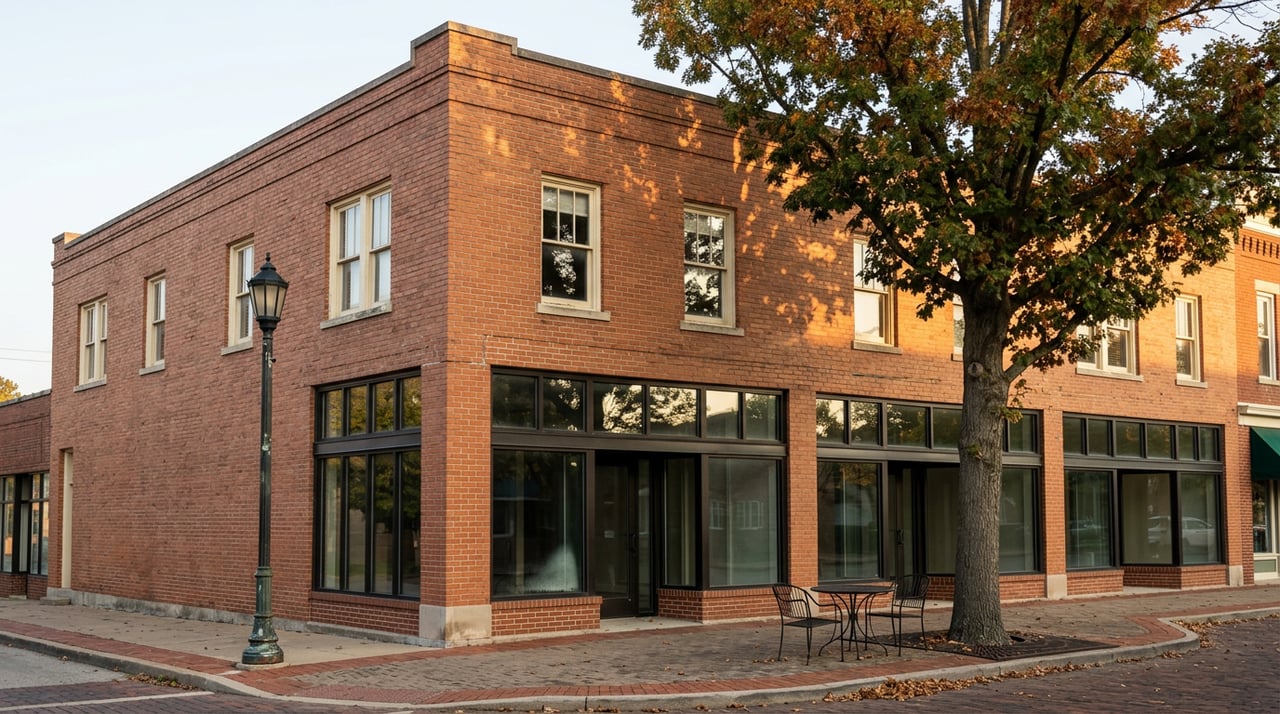
Walk past 139 North 6th Street on a Thursday evening this fall and you'll see something Seward hasn't been able to count on for more than a year: a full lot, plates moving past the window, the kind of steady dinner-hour traffic that used to be background noise before it became something people worried about out loud.
That's Sixth Street Cafe, and if you've lived in Seward for a while, you already know the shorthand. This was Cafe on the Square before it wasn't. The restaurant closed at the end of July 2024, planning to relocate one block north and reopen within weeks. Owners Chelsey Kosmicki, Tyler Bockoven, and Audra Jensen had bought the new building outright instead of renting, with room for roughly 70 chairs instead of 35 and a party room for larger groups. Then the company hired to install the kitchen hood system got it wrong. Kosmicki described going back through every receipt trying to recoup what they'd spent, and the delay stretched from the promised few weeks into more than a year of a dark storefront and a staff sitting on standby with nowhere to clock in.
During the worst of it, they leaned on the town in ways that don't show up in a typical business profile. They caught some catering work using the kitchen at Squire Ward's Public House while their own space sat gutted. Audra Jensen launched a GoFundMe to help cover a mortgage and utilities on a building that wasn't generating a dollar. Kosmicki told a local TV crew it felt like COVID again, not because of the shutdown itself but because of losing the regulars, the daily contact that makes running a small-town cafe feel like more than a job. The doors are open now. Sixth Street Cafe currently sits at number one of 15 restaurants tracked in Seward on Tripadvisor, and one recent review sums up the mood in five words: "Back open with wonderful food."
If you're reading roundups of small towns this season, the formula is usually the same. Find the new coffee shop. Find the boutique that just took over an empty storefront. Frame the town as a place that's "having a moment." Seward's actual fall story runs the other direction. The thing worth paying attention to isn't a grand opening, it's a comeback that took three years from decision to reopening, survived a botched contractor job, and only made it across the finish line because enough people in this town kept showing up for it. That's not a novelty story. That's a pattern, and once you see it, you start noticing it everywhere downtown.
What Never Left
Take the Seward Farmers Market. It's not new, it's not changing, and that's precisely the point this time of year. Per the Four Corners Health Department's posted schedule, the market runs Wednesdays from 5 to 7 p.m. and Saturdays from 8 a.m. to noon on Courthouse Square, and it continues through the end of October. That means as of this writing, there are still several weeks of market mornings left before the season closes, and the vendors setting up folding tables in October are largely the same faces who were there in May. Nobody's trying to reinvent the market for fall. It's the same rhythm, just with squash and storage crops replacing the early summer produce.
The same logic holds a few miles outside town. Junto Wine, a working vineyard and winery under 10 miles east of Seward off Highway 34, produces and bottles every wine on site from locally grown grapes. It isn't a pop-up or a seasonal attraction. It's an operating vineyard that happens to be most interesting to visit in the fall, when harvest is the actual activity happening on the ground rather than a marketing detail on a label. Back on the square, the Red Path Gallery and Tasting Room occupies a former bank building at 514 Seward Street that has stood since 1886. The gallery didn't choose that building for atmosphere. The building was simply already there, doing something else for over a century, and someone eventually figured out what else it could hold.
None of these are new stories. That's what makes them worth naming instead of skipping past. A town that measures itself by openings and closings will always look thin in the years between booms. A town that measures itself by what keeps running, season after season, tells you something steadier.
The Calendar Doesn't Reinvent Itself Either
The 156th Seward County Fair wrapped up in July, a run that stretches back well over a century. Seward has called itself Nebraska's Fourth of July City since 1868, and in 1976 it hosted the state's official Bicentennial Independence Day celebration, a detail the town still points to with real pride. A place with roughly 7,600 residents draws close to 40,000 visitors on that one day. That's not a fluke of good weather. It's a town that has practiced showing up for itself for a century and a half, and the muscle memory carries into everything smaller that happens the rest of the year, including whether a cafe survives its own relocation.
That same muscle memory shows up on the fall calendar. The Seward Holiday Craft Fair returns to downtown on November 21, and Miracle on Seward Street, the holiday vendor market that's typically held the Saturday after Thanksgiving, has run in years past on the same late-November weekend as the Christmas festival events at the National Guard Museum. These aren't new additions competing for attention. They're the events that already have a following, back on the calendar because that's what they do every year.
If you want a full dinner or drink option before either event, RUE 6 on South 6th Street has kept its gastropub menu running as one more anchor a few doors down from Sixth Street Cafe, which means downtown now has more than one reliable place to end up on a Friday night than it did for most of the past year.
What This Actually Tells You About Seward
The lesson in all of this isn't really about restaurants or markets or a fair. It's about what a town like this rewards. Sixth Street Cafe didn't reopen because someone found a clever new concept or a bigger marketing budget. It reopened because three owners refused to fold on a project that kept going sideways, and because enough neighbors backed them through a GoFundMe, a borrowed kitchen, and more than a year of closed doors. The farmers market doesn't need reinventing because the same growers keep showing up. The winery and the gallery aren't new discoveries, they're just still there, doing what they've always done, waiting for someone to notice on a Saturday afternoon.
That's the actual thesis worth carrying into the next few months here. If you're weighing whether Seward still has the texture that made you want to live here in the first place, look past whatever's newest. Look at what came back. Look at what never stopped. That's the more honest measure of a town, and this fall, Seward is passing it.
If any of this has you thinking about what it would take to plant roots in a place like Seward, whether that's a home in town or an acreage on the edge of it, I'd love to talk through what you're looking for. Reach out to Ashley Terry and let's connect.